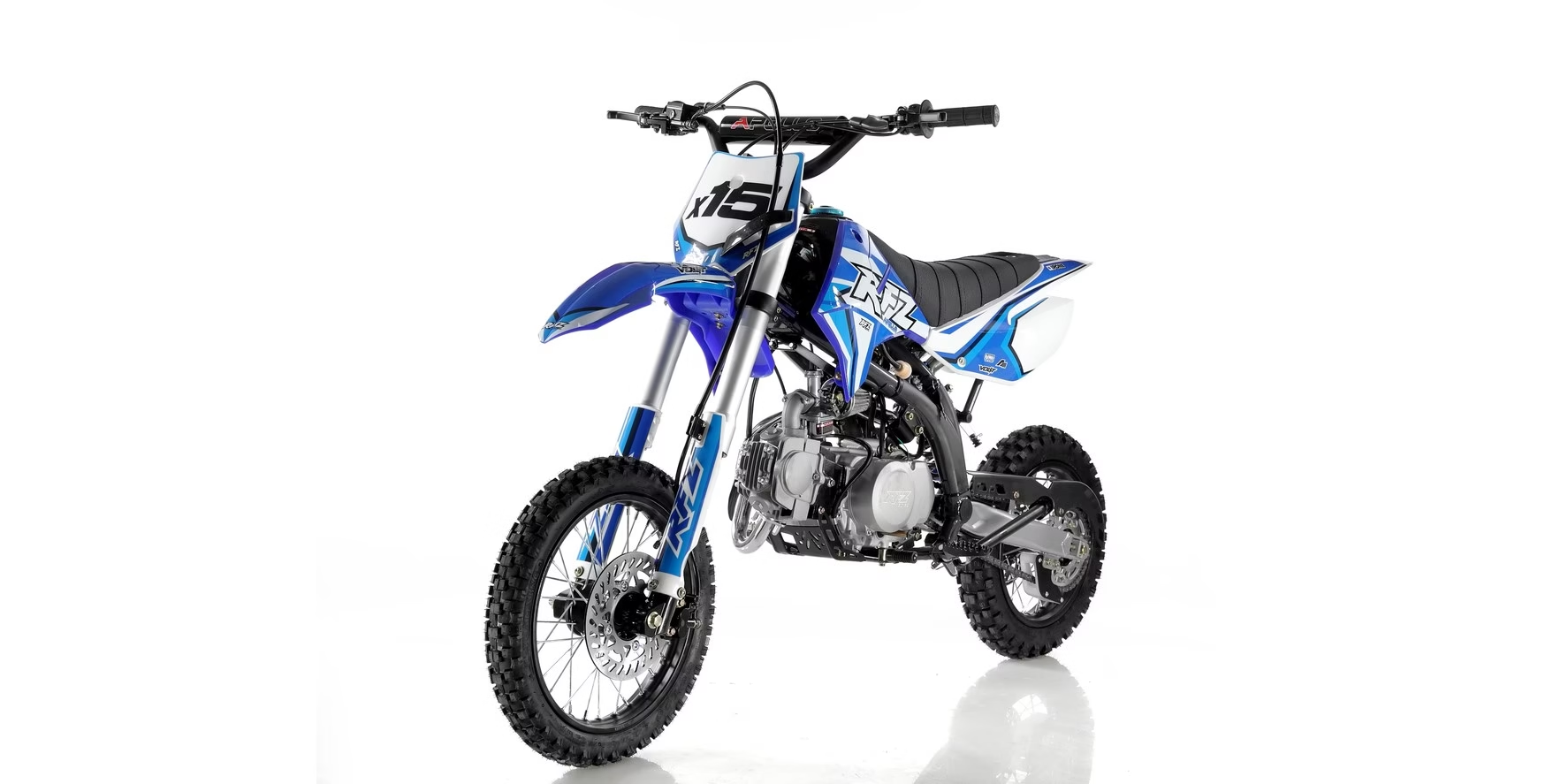
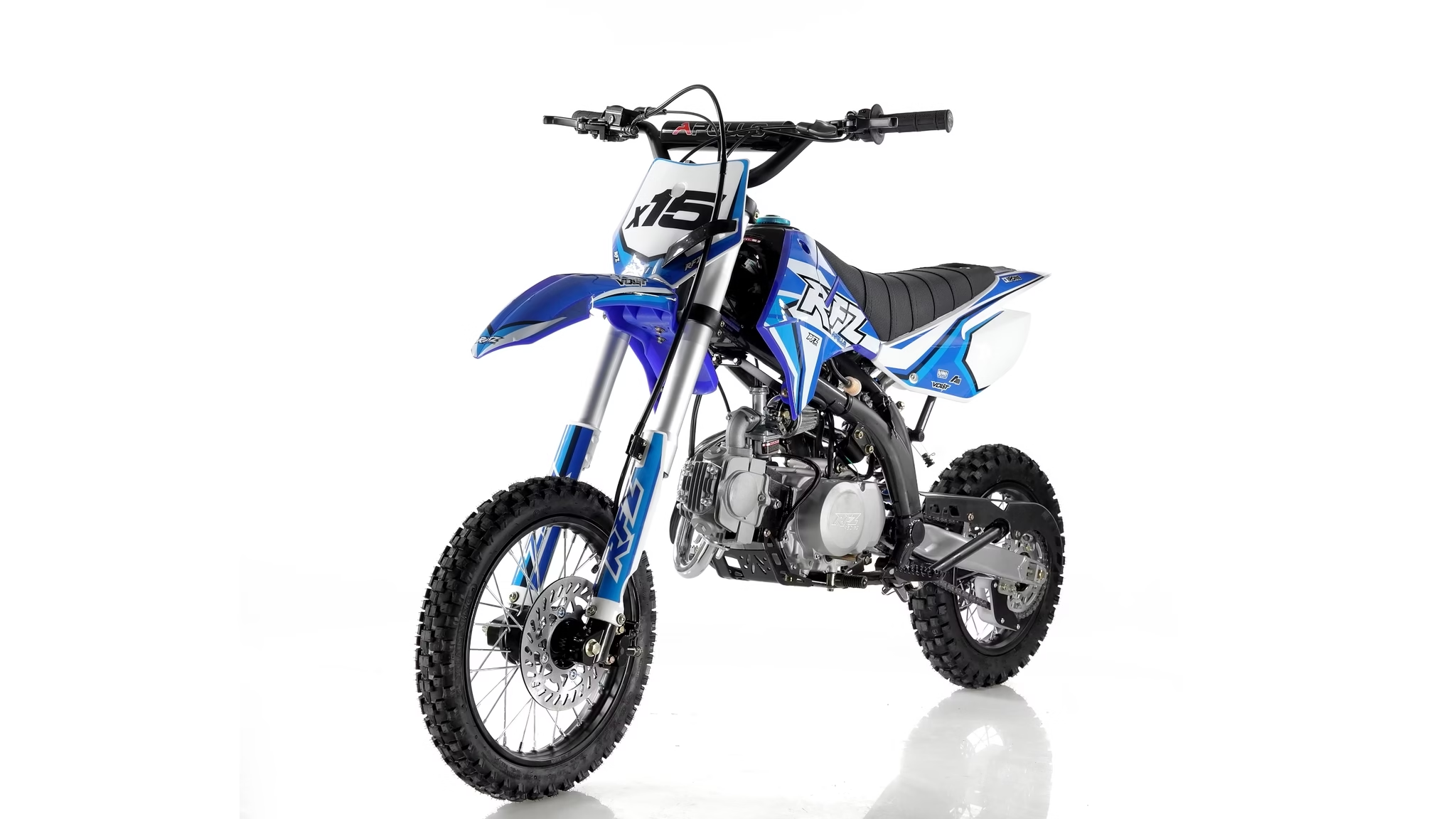
The DB-X15, one of nine 125cc models in the Apollo dirt bike range.
When comparing an Apollo 125cc Dirt Bike, engine displacement is only the starting point.
Apollo lists nine 125cc models in two groups: five compact bikes (DB-X5, DB-X6, DB-X14, DB-X15, DB-X16) and four full-size bikes (DB-X18, DB-X19, Thunder 125, Thunder T20).
All nine share a 125cc four-stroke, air-cooled, single-cylinder engine, kick start, hydraulic disc brakes front and rear, and a listed rider age of 12–16. The tables below cover what differs.
Choosing among nine bikes comes down to three questions. How big is the rider, how much shifting do they want to do, and how tall a seat can they handle?
The sections below answer each one using Apollo’s own listed figures, model by model.
Apollo 125cc Models at a Glance
| Model | Top speed | Transmission | Tires (F / R) | Weight |
|---|---|---|---|---|
| DB-X5 | 46 MPH | 4-speed manual | 14 / 12 in | 140 lb |
| DB-X6 | 46 MPH | 1-speed automatic | 14 / 12 in | 140 lb |
| DB-X14 | 46 MPH | 4-speed semi-auto | 14 / 12 in | 165 lb |
| DB-X15 | 46 MPH | 4-speed manual | 14 / 12 in | 165 lb |
| DB-X16 | 46 MPH | Automatic | 14 / 12 in | 165 lb |
| DB-X18 | 50 MPH | 4-speed manual | 17 / 14 in | 174 lb |
| DB-X19 | 50 MPH | 4-speed manual | 17 / 14 in | 174 lb |
| Thunder 125 | 50 MPH | 4-speed manual | 17 / 14 in | 174 lb |
| Thunder T20 | 50 MPH | 4-speed manual | 17 / 14 in | 174 lb |
Figures are as listed on each Apollo product page, which notes that prices and specifications are subject to change without notice.
Compact or Full-Size: The First Decision
Apollo splits its 125cc range cleanly in two, and almost every other difference follows from that split.
The five compact bikes run 14 in front and 12 in rear wheels. They list 46 MPH and weigh 140 to 165 lb.
The four full-size bikes run 17 in front and 14 in rear wheels. They list 50 MPH and weigh 174 lb each.
The speed gap is only 4 MPH on paper. The real difference is the ride: bigger wheels, a heavier bike and a taller stance.
How the Models Compare
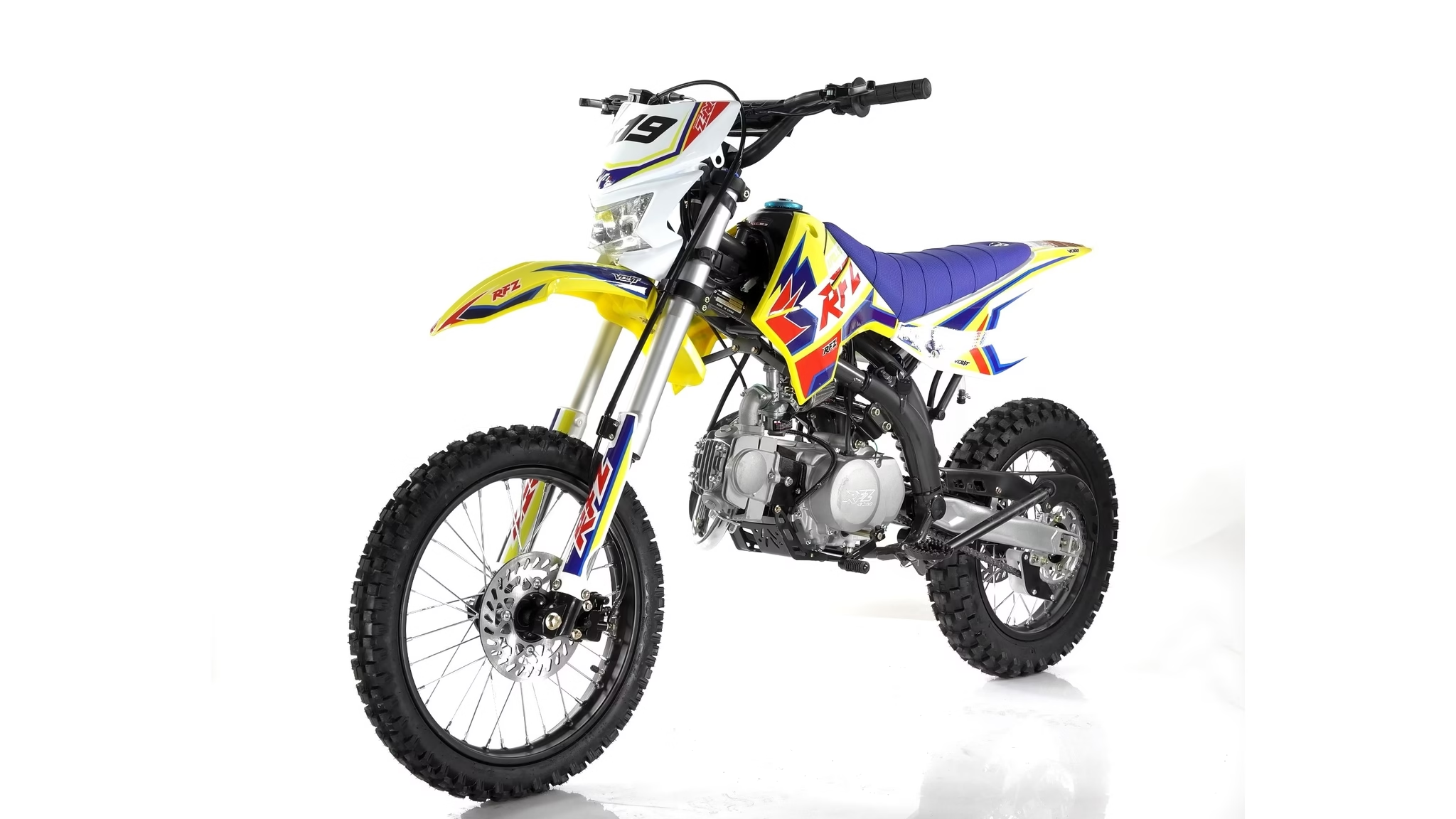
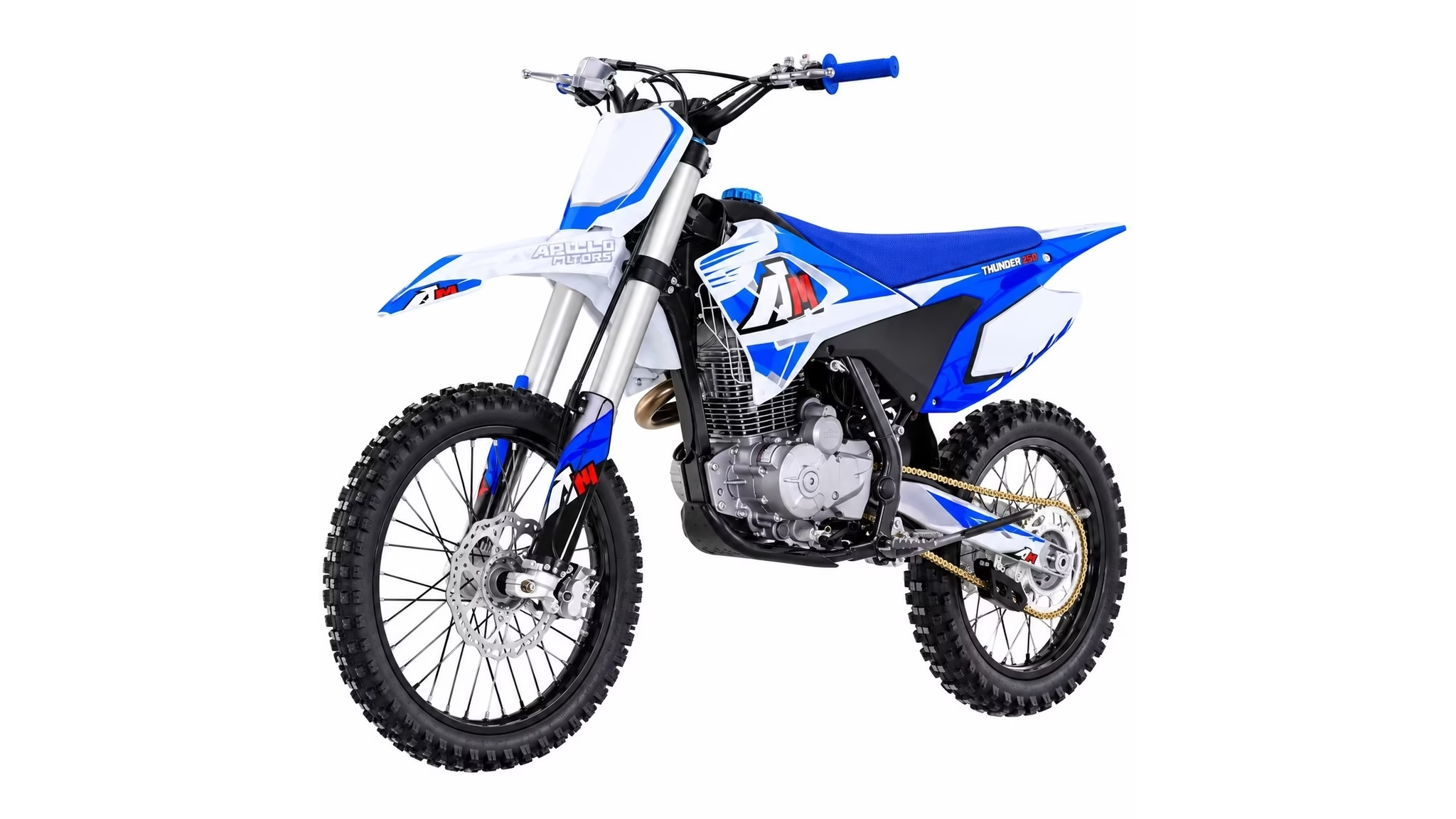
The DB-X19, a full-size 125cc model.
- Same bike, different controls: The Apollo DB-X5 is manual and the DB-X6 is automatic, with the same weight, wheels and single-tube frame. The Apollo DB-X15 and DB-X16 are a matching manual and automatic pair.
- Frame: Single-tube on the DB-X5 and DB-X6, twin-spar heavy-duty steel on the other seven.
- The in-between option: The DB-X14 is the only 4-speed semi-auto, with the DB-X15’s weight but a lower 30-inch seat.
- Stepping up in size: Moving from the DB-X15 to the DB-X19 adds 3 in at the front wheel and 2 in at the rear, 4 MPH, 9 lb, 1.5 in of seat height and 3 in of ground clearance. The trade-off is a smaller fuel tank, 3.2 L instead of 4.7 L.
- DB-X18 versus the rest of the full-size group: It has the lowest seat and keeps the larger 4.7 L tank, but gives up ground clearance.
- Near twins: The Apollo DB-X19, Thunder 125 and Thunder T20 list almost identical numbers. Apart from the Thunder 125’s PZ27A carburetor, they differ mainly in colors: six for the DB-X19, four for the Thunder 125 and three for the Thunder T20.
- Carburetors: The DB-X5 specifications list a PZ19, while most of the range lists a PZ26, so the DB-X5 should not share a spec block with its siblings.
Pick the Model That Fits Your Rider
Start with the rider, then match the bike. Here is how the range sorts out.
- Simplest first bike: The Apollo DB-X6 is automatic, weighs 140 lb and uses a single-tube frame.
- Automatic with the heavier frame: The Apollo DB-X16 is automatic, lists 165 lb and uses the twin-spar steel frame.
- Learning to shift: The Apollo DB-X14 is the only 4-speed semi-auto. Its 30-inch seat is the lowest compact option listed here.
- Ready for a manual: The Apollo DB-X15 pairs a 4-speed manual with the twin-spar frame and a 4.7 L tank.
- Full-size, lower seat: The Apollo DB-X18 has the lowest seat in the full-size group and keeps the 4.7 L tank.
- Full-size, most colors: The DB-X19 comes in six colors, against four for the Thunder 125 and three for the Thunder T20.
Setup Differences Worth Knowing
Two bikes that look alike on a spec sheet can still be built differently. Apollo’s listings show a few differences that are easy to miss.
Frames
The DB-X5 and DB-X6 use a single-tube frame. The other seven models use a twin-spar heavy-duty steel frame.
That is why the DB-X6 and DB-X16 share a control type but not a build.
Carburetors
The DB-X5 lists a PZ19 carburetor. Most of the range lists a PZ26, and the Thunder 125 lists a PZ27A.
Any tuning notes should stay with the model they were written for.
Fuel Tanks
The DB-X15 carries 4.7 L, while the DB-X19 carries 3.2 L. The DB-X18 keeps the larger tank.
A rider moving up to the DB-X19 gains size but gives up some range.
Model-by-Model Notes
The Compact Five
The DB-X5 is the baseline: manual, 140 lb and a single-tube frame. It is also the one model with the PZ19 carburetor.
The DB-X6 matches the DB-X5 in weight, wheels and frame, but swaps the manual for a 1-speed automatic.
The DB-X14 moves up to the twin-spar frame and 165 lb. Its 4-speed semi-auto and 30-inch seat make it the gentlest step toward shifting.
The DB-X15 is the manual in that same frame. It is the compact bike for riders who want full control of the gears.
The DB-X16 is the automatic version of the DB-X15. Weight, wheels and frame stay the same.
The Full-Size Four
The DB-X18 is the odd one out. It has the lowest seat and the larger tank, but gives up ground clearance.
The DB-X19 is the model most buyers will compare against the rest. It offers the widest color choice, with six options.
The Thunder 125 lists almost the same numbers as the DB-X19. Its PZ27A carburetor is the main spec difference, and it comes in four colors.
The Thunder T20 is the third near twin, with three colors. For a buyer, the choice often comes down to look and availability.
Reading the Speed Figures
Top speeds are manufacturer-listed, not guarantees. Rider weight, terrain, setup and maintenance all change what a rider actually sees, so quote the figure with the model name beside it.
Write “the DB-X15 lists 46 MPH” rather than “the Apollo 125cc does 46 MPH.”
Inside the compact group, the transmission does not change the listed speed. The manual DB-X15 and the automatic DB-X16 both list 46 MPH.
The full-size four all list 50 MPH, so speed alone will not separate them. Look at seat height, tank size and carburetor instead.
Planning for Shipping and Storage
Apollo lists the DB-X5 at 140 lb, the DB-X15 at 165 lb and the DB-X19 at 174 lb. For dealers, weight is relevant to shipping, handling, storage and assembly planning.
Several product pages leave the wheelbase blank. Where a field is not listed, do not fill it in from another model.
A bike should be sorted by weight on arrival. Three tiers cover the whole range: 140 lb, 165 lb and 174 lb.
Confirm assembly and packaging details with Apollo, since they are not listed in this guide.
Rider Age, Fit and Braking
Apollo lists a rider age of 12–16 for every 125cc model. Check the current product page before quoting it.
Seat height is the quickest fit check. The DB-X14 has a 30-inch seat, and the DB-X18 sits lowest among the full-size bikes.
All nine use hydraulic disc brakes front and rear. Braking hardware stays the same as a rider moves up in size.
Browse the Wider Range
Readers can browse the wider Apollo Dirt Bikes range to compare 125cc models with other engine categories.
It is the quickest way to see where the 125cc bikes sit next to Apollo’s smaller and larger models.
For Dealers and Wholesale Buyers
For businesses evaluating Wholesale dirt bikes, keep the model specifications consistent with the current product catalog and contact Apollo for information that is not published online.
A short checklist keeps model listings accurate:
- Exact model name: Use DB-X15 or Thunder T20, never a generic “Apollo 125cc.”
- Transmission: State manual, semi-auto or automatic for every model.
- Look-alikes: The DB-X19, Thunder 125 and Thunder T20 need separate listings.
- Carburetor: Do not share a spec block between the DB-X5 and the rest of the range.
- Final check: Compare every figure with the live product page before publishing.
Final Thoughts
Apollo’s 125cc range is a set of distinct bikes rather than one specification. Choosing between compact and full-size, then manual and automatic, narrows it quickly.
For businesses seeking dealer information or help with product details, Apollo ATV provides a direct point of contact.
FAQs
1. What affects the performance of an Apollo 125cc Dirt Bike?
Model configuration matters, including carburetor, transmission, frame and weight. Real-world results also depend on operating conditions.
2. Which Apollo 125cc models list the highest top speed?
The DB-X18, DB-X19, Thunder 125 and Thunder T20 list 50 MPH, against 46 MPH for the five compact models.
3. Which Apollo 125cc models are automatic?
The DB-X6 and DB-X16. The DB-X14 is a 4-speed semi-auto, and the other six are 4-speed manual.
4. What rider age does Apollo list for its 125cc models?
12–16 for every model. Check each product page for current guidance.
5. Where should specifications be verified before publication?
Use the current Apollo product page for the exact model, such as the DB-X19 specifications. Apollo notes that prices and specifications may change without notice.
6. Which Apollo 125cc is best for a first-time rider?
The automatic DB-X6 and DB-X16 have the fewest controls. The DB-X14 is the step between automatic and manual.
7. Do all Apollo 125cc models use the same carburetor?
No. The DB-X5 lists a PZ19, the Thunder 125 lists a PZ27A, and most of the range lists a PZ26.